

Ellis County Stamps
Blog Catalog

Subscribe To

 Posts
All Comments
Posts
All Comments
Showing posts with label ellis county. Show all posts
Showing posts with label ellis county. Show all posts
Tuesday, June 2, 2009


Sunday, September 7, 2008
Reagor Springs Resort?
Entering the Twentieth Century, electricity was changing the World and Ellis County. The electric railways had already changed travel up in the northern states. The interurban electric railway in North Texas had started in Denison on May 1, 1901. Speculators were planning there lines from Sherman to Dallas then to Waxahachie. Why not patch Waxahachie into Ennis? To make sure people will travel that way J. T. Voss of Ft Worth would build a Resort in Reagor Springs! What? Reagor Springs? Yup the current drag race haven, beer store populated pit stop on 287. Though the Southern Traction wouldn't open for service from Dallas to Waxahachie until October 3, 1912 and then from Waxahachie to Hillsboro a year later on October 20, 1913, people were already securing right-of-ways. Just like the railroads after the civil war people were trying to get the property secured for the lines first. Though the line was never built between Waxahachie and Ennis, Mr Voss originally had grand plans for the line.
Waxahachie Enterprise July 4, 1902 Electric Lines in Texas cont'd Another inter-urban line is projected by a company recently chartered under the laws of the state and which has already run two surveys between Ennis and Waxahachie, a distance of about fifteen miles. J. T. Voss of Fort Worth, former president of the Poly-chnic Street Car company of this city, is the right-of-way agent for this company, and is no securing options on the right-of-way between Ennis and Waxahachie. Mr. Voss was here yesterday and said he had secured most of the route on one of the lines, and it was intention of the company to commence construction by the first of next September. This company too, contemplates a belt line but for the present the route is not made public. At Reagor Spring, midway between Waxahachie and Ennis, there will be a resort on which company expects to spend considerable money in making it one of the most attractive places in central Texas. A similar resort is now being arranged for at Handley by the North Texas Traction company. - Fort Worth Register.-Waxahachie Enterprise Resorts were common attractions on the interurbans to encourage human traffic on the rail cars. WoodLake was a popular resort on the Denison-Sherman line. Quite a succes in it's time with swimming hole and a theater.
Monday, September 1, 2008
HANS SMITH: The Silver Tongued Orator

Hans Smith, born in Pennsylvania Sept. 15, 1799, was already a well established man before he took his chances with the Peter's Colony. He had represented Missouri and Arkansas in both Houses of government. He was General Commander of the Missouri militia for two years. Appointed Bank Examiner by Governor Boggs over the State of Missouri on Sept. 1, 1840. He even gave Missouri's famous "Bullion" Senator, Thomas Benton, a run for his money in one election for the Missouri Senate race. Hans Smith was a very big fan of President James K. Polk and was a 100 percent behind Polk wanting Texas to join the Union. In fact he named one of his sons James K. Polk Smith. The big problem with Texas joining the Union was the abolitionist felt Texas being a slave state would be moving the country in the wrong direction. Hans was a slave owner so I imagine he had no problem with this.

In the fall of 1845 Hans and his family began their move to Texas from Crawford County Arkansas. His wife Nancy and their children Robert aged 19,Sid aged 17, George aged 15, William Penn aged 12, Leila aged 8, and the baby ("little Jimie") James K. Polk started their journey. Also the slave Jerry was with them. They left Arkansas in three covered wagons drawn by oxen. They had all their belongings and necessities in their wagons. On the Smith's way to their future home they crossed the Red River and came into contact with the founder of the Dallas village,John Neely Bryan, at his one room cabin on the Trinity River.

From Bryan's home the Smiths forded the Trinity River and camped in the current location of Lancaster, Texas. Hans was headed toward Waco Country(named after the Indian village near the land) where Waco is today. While following the road south which was probably what became the Preston Road (Preston Road/ military road/ Shawnee trail)they went off a fork to the left taking them southeast(not their intended direction due south.).
 They ended up on the north bank of Red Oak Creek in between the present day Rockett and Palmer, Texas. There camp was near Rutherford's crossing at Red Oak Creek. When they camped the kids went fishing and Hans killed some game. Later, Hans went walking on his own taking in the view of the Black Prarie land. South of Red Oak Creek Hans topped a beautiful hill and looked over the prairie valley. (I've always wondered if this hill may be where Hans is currently buried in Smith Cemetery. He is the first buried here and it sits upon a knoll looking over a valley.) Then he knew this was his new home! Hans said to his wife, "Nancy, I think we have traveled far enough. Their is plenty of timber and water here.
"

Hans built his house and claimed his 640 acres from the Peters Colony contract.Hans was elected representative of Navarro County. Two notable contributions to Ellis County by Hans Smith was he brought the first cotton seed to the area and he sat at the table for the organization of Ellis County out of Navarro County. It was thought that Texas lands could not grow cotton but they couldn't be more wrong! The Ellis County area at one time became the world's largest producer of cotton and it all started with Hans Smith. With the success of the cotton in the area Hans built the areas first cotton gin and ginned the areas cotton for 4 years. He also built a dry goods store being that the nearest was either north to Dallas, Texas or south to Corsicana, Texas. In 1852 Has Smith headed to Houston to get supplies for his dry good store. He took a $1000 of his own and $500 from a neighbor and left for Houston for supplies. He would not return. He was robbed a murdered in Houston. Nancy got her kids together and went to Houston putting Hans body in a metallic coffin. They brought him back and buried him on the beautiful knoll on their property now Smith Cemetery.
 Hans is the first burial in the Smith Cemetery. Emory Rogers said he was the greatest orator he ever heard and called Hans the silver tongued orator. He could have been one of the greatest politicians and business man in Ellis County history but his life was cut short March 20, 1852 at the age of 52. His wife carried on the honor of the family and paid back the neighbors $500 that had been stolen from Hans and kept the family going. She also settled his estate among her and the children.
"Under certificate 257 Volume 1, a survey of 640 acres granted in Ellis County was made in the name of Hans Smith, who emigrated to Texas and entered the colony which was granted to Peters and others prior to July 15, 1848, under patent 362, Volume 10, to the Heirs of Hans Smith deceased."
resources
The story of the pioneers, Hans and Nancy Owen Smith
Ellis Country History-pg 70
Hans Smith pg 117-119
Friday, August 8, 2008
Outside Bathroom Ellis County Courthouse
 Picture Courtesy of Ellis County Museum.
Looking center left bottom in this picture there is the old outside bathrooms which included showers. This picture I believe is looking North West down main street. Picture probably shot from the top of the Rogers Hotel and was taken circa 1919. It is said these bathrooms were put in for folks that traveled from around the county so the stinky travelers could take a shower and clean up for court. Remember at this time no ac in cars and as you can see on main street they still rode horse drawn wagons into town.
 close up of bathroom
Thanks to Shanon Simpson for the info
Wednesday, August 6, 2008


Friday, July 18, 2008
Places In The Heart:Bethel Methodist Church

This church was used in the beginning and the end of the movie. At the end was an emotional scene about forgiveness. It's a very interesting peaceful setting. Many Sims are buried in the cemetery across the road from the church and the God's acres pavilion was used in the second dance scene. I believe Ellis County Commissioner Heath Sims is a current member of the Church. The Sims were early settlers of Ellis County and founders of the Bethel Church. I believe N. P. Sims is Heath's Great Great Uncle. The church is in the vicinity of the community of Boz.


I sneaked a picture of the inside through a small clear rectangular piece of glass on the door. Wood floors and wood pews are still their like in the movie. GPS approximate location is 32 deg 17' 44.45"N 96 deg 54' 53.45"W
This video is spliced with my video of the current appearance of the Bethel Church. Notice the large bushes are gone beside the entrance. There is also a bar across the circle stained glass dove picture in the movie but not now. Also in the movie the beautiful windows are open as is the front door for air circulation. Now the church has ac.
Tuesday, July 1, 2008
Citizen's National Bank 140 Years Old Today!

Serving generations of area families for over 140 years.
First building in Waxahachie
"On July 1, 1868, as the Civil War closed, Ferris & Getzendaner Attorneys-at-law began to offer banking services "that would add something to the meager compensation that might come from the practice of law." The money to meet this business had to be taken periodically by horse and rider to Houston through bad lands infested by robbers and murderers. Their original bank building was a double-room wooden structure, but from these crude beginnings 128 years ago, the acorn that today has become the Citizens National Bank was planted. Then, as today, the bank had become a good neighbor, and a vital spark to the economic growth of Waxahachie."-taken from a 1996 pictorial book of Ellis County.
The first depositor was R. A. Davis on July 10,1868. Davis was also one of the founding members of the town of Waxahachie in 1851. He deposited $230.75 of hard money(Gold and Silver probably.) First the bank was called Ferris and Getzendaner until June 25, 1884 when it became The Citizens National Bank of Waxahachie. At this time the bank had capital of $100,000 surplus of $50,000 and a profit of $54,000.-History of Ellis County
First President :1868-1887 Captain Getzendaner
Tuesday, June 24, 2008
The preceeding counties before Ellis County was formed
Before Ellis County, Milam county (at one time covered 1/6 of Texas) reached into the Ellis county area then Robertson (named for empresario Sterling Robertson rival of Stephen F Austin)covered the area then Navarro was formed over the area. Then December 20, 1949 Ellis County was formed out of Navarro county with a hundred signatures from local residents.
Sunday, May 25, 2008
Dynamos and Storms In Waxahachie 1889
In 1889 as Waxahachie began to assimilate to the technological advances of electricity. They had to deal with myths and superstition that surrounded electricity. Did electricity effect the atmosphere when produced by dynamos? Experts were asked their opinions on the possibility of side effects of the new advancement in Ellis County . They assured the citizens that dynamos did not cause the unusual storms that coincided with the beginning of electrical power.
From the Waxahachie Enterprise:
From the Waxahachie Enterprise:
9-6-1889 ELECTRICTY AND STORMS -
What Experts Think of the Effects of Electric Dynamos upon the Elements. The unusually heavy rains that have fallen during the past few weeks have attracted the attention of many throughout the country, who attribute the meteorological storms in part, to the large amount of electricity generated by the numerous dynamos in operation at present.
A Star reporter interviewed Mr. West of the New American electrical arc
light company relative to the cause of the heavy rains, and in response
to questions about the dynamo-electric effects upon the elements, he
said:
"I cannot see how the electricity generated by the dynamos could effect
the elements sufficiently to induce the falling of such heavy rains as we
have had of late. People out in Nebraska and other Western states argue
that the enormous quantity of steel rails laid over the thousands of
miles of surface in the United States have, in a great measure,
exercised-an influence on the elements, through their power of attracting
heat, and conveying the same over a great extent of territory, the rails
also acting as a perfect chain of lightning rods. It is also claimed by
many of the agriculturists of the west that steam generated by
locomotives and the great velocity of railroad trains in traversing the
country has much to do with changing the electrical current. Of course, I
cannot, from a scientific standpoint, authoritatively speak as to the
absolute truthfulness of such statements
'
Mr. Robert Grimshaw, the well know scientific expert of No. 21 Park row,
upon being asked to express his opinion in regard to dynamo electricity
having an effect upon the natural elements, said:
"The amount of electricity used for commercial purposes in the United
States would, as compared with the amount of energy represented by a
single storm, be but as a drop in the bucket, even supposing that it ran to waste and became apparent in the work of storms. As a matter of fact," said Mr. Grimshaw, "of all the currents generated in any dynamo every fraction of its percent is fully accounted for, either as work done by a motor or light in the lamps supplied by the dynamos, or friction and resistance in the machine and the wires carrying the current. It is not all recovered, of course, but it is accounted for as work or waste of some sort in the system, and therefore does not go wandering about trying to disturb the elements. If it did there is not enough of it to amount to anything.
Mr. Benson Wright of No. 118 Liberty street, a well known Boston expert,
said:; " I do not care to express my opinion upon the subject, but I can
emphatically say that the electricity,generated by dynamos has nothing
whatever to do with the storms that have followed each other so rapidly within the last month."
Monday, May 19, 2008
Pictures of the Murder scene on E Pecan Tree Rd.

What's left of the 100 year old Pecan Tree on E Pecan Tree rd and Highway 77 in between Waxahachie and Italy. The tree was mistakingly cut down and mulched by a txdot contractor. Post on the tragedy is here.
Here are more pictures of the destruction.


Sunday, March 30, 2008
Medicine Crow

Medicine Crow
Little known music group from Ellis County circa 1989-90. Members Andy,Barry,Bryan, Brian, and Charlie all from Ellis County. Main reason is they only put together one Album Stomp'n in the Churchyard. The band tried an experimental folk rock formula. Using banjos, mandolins, casio keyboards,hardwood floors, drum machines,harmonica and the cello along with the standard acoustic guitars(6&12strings,electric guitars (bass 6string). Technology of the time only allowed lo-fi 4 track tape recording. Medicine Crow didn't have the luxury of digital recording.
After Medicine Crow
Andy(guitarist/vocalist/songwriter) also performed at DBU with his friend Russel in a group called Swahili Monkey Brothers. Later graduated from DBU and married having one son they moved to New Mexico. Still involved in church functions and playing his guitar and singing in the fashion of Dylan. The Lord took Andy beyond the stars in the Mid 90's. His wife has continued their dream of being missionaries and with their son teaches in China.
Barry (Guitars,mandolin,vocals,keyboard)went to East Texas State in Commerce with Bryan and Brian. Do to lack of funds dropped out and returned to Ellis County and played with a band called Hung by Vigilantes. Currently Barry manages a business in Ellis County.
Bryan (Drummer,vocals,keyboard)graduated from East Texas State and joined the Airforce. From the University to the Air Force Bryan learned the trade of radio/tv and became a video editor for Nasa. Bryan was responsible for any video released by Nasa on the Hubble Telescope. In Circa 2006 Bryan resigned from Nasa and joined Michelle Malkin at the conservative political hotspot blog Hotair.com. He resigned from Hotair.com in March 2008 and was hired to produce the Laura Ingraham show a nationally broadcasted conservative radio show in over 300 radio stations where he is currently employed.
Brian (Vocals,Banjo,harmonica) went from East Texas State to Denton where he obtained his degree in art from North Texas State University. He later worked security for an art museum in Ft. Worth for a stint. He also was involved in the set up of exhibits while at the museum. During this time he was highly involved in his video art. Presenting his art in exhibits all over Texas. Eventually all over the United States and to Europe. Later he got a job moving high end residences that usually involved moving art. Currently employed by a wealthy individual in Dallas to work on a metal project (not his art).
Charlie (Bass,background vocals,tech,mixer) is highly involved in his Waxhachie Bible Church. Always running their website, working on their computers, running their sound board or playing the bass. Over a year now Charlie has fulfilled his life's calling to be a missionary to Equatorial Guinea, Africa. He and his wife Bridget along with their children Briana and Micah(who was in the womb during the album's recording. we feel he may have suffered some damage to the exposure of the music :)) live in the Coastal jungle. His wife a student of Southwest Assemblies of God college has taken her English teaching skills and are working on translating the new testament into the native language, Fang(pronounced like Fawng). Suffering from malaria and separation from the Western comforts they keep moving forward with the good work.
Saturday, February 2, 2008
Stairway to nowhere?

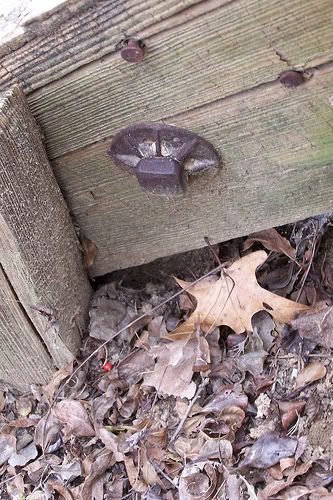
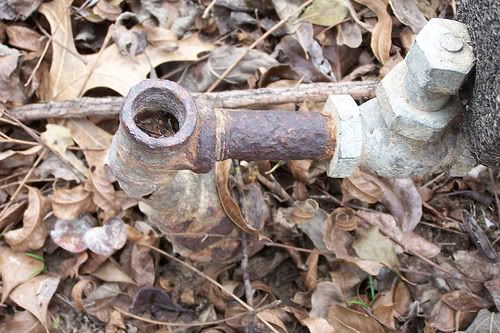
Through a Ellis County Sheriff friend, I was given a tip on a location that may have historical value. He told me in the southeastern region of Ellis County there is a stairway that goes up a hill . It is made of lumber and goes up a wooded hill near a creek by railroad tracks. I went to the location on Sandswitch Road and being summertime was not able to locate it. Returning this winter, sure enough, there it was. The Sheriff said he had metal detected the area and found coins mainly from the 1930's. There is an abandoned house and barn just east of the stairway where unfortunately people dump stuff. The stairs are in two sections. A long one goes close to the top until the angle changes then another stairway goes the rest of the way to the top. Where they seperate you can see an old waterline(I'm guessing for water) and it runs under the top section of stairs. Maybe it was a way for people who lived on the hill to catch the train?
Friday, October 26, 2007
Hauntings, Ghosts and Monsters of Ellis County
The Catfish Plantation is probably Ellis County's number one location for experiencing the indigenous phantoms. I spoke to a lady and her husband who have worked for years at the Catfish Plantation and they say it is all true. The lady acquaintance told me that when the Ghost get mad they like to "break wine glasses and cause trouble." She told me that the ghost have written words on the windows when they fog up. The three Ghost that reside here are "Elizabeth, Caroline and Will. Both Caroline and Will died of natural causes while Elizabeth was murdered on her wedding day."-W.D.L. Elizabeth was murdered in the bathroom which is said to be the most haunted place. When I was growing up I always heard that the Elizabeth lady would walk down the street in her wedding gown looking either for her lover or her murder.
CATFISH PLANTATION THE MOST ACCEPTED VERSION
->Texas ghost hunter site.
ROGERS HOTEL
"Another famously haunted business in Waxahachie is the Rogers Hotel.
First built by Emory Rogers as a log cabin at a small town crossroads, this building has turned into a grand establishment" "This hotel is said to have had more than 300 ghosts in the building. The most known spirits are a cowboy, a little girl who drowned in the hotel pool and Emory Roger’s son. These ghosts roam the hotel appearing in several different spots. The little girl walks the lobby, while Roger’s son haunts the elevator and the cowboy makes appearances in room 409, which is said to be the room with the most ghostly activity."-WDL Emory Rogers was the founder of Waxhachie and a Civil War Veteran. He donated land for the Courthouse. He originally settled near Milford. Cleared the land on Richland creek and later came in 1847 where the Rogers Hotel is now and lived in a tent while he built his cabin.
CONFEDERATE GHOST
"One story says that the ghost of a confederate soldier walks down Becky Lane in Waxahachie at night. Private John Hemerich's is suppose to be the soldier ghost. Becky Lane is supposedly the site of the last Union hanging after the Civil War."-WDL I have never found any Historical evidence of this hanging but interesting when you have to realize that the Reconstruction was brought right into the heart of our County! Just a mile or so from Rockett Springs where the first Confederate soldiers from Ellis County gathered to enlist in Parson's Brigade in 1861!
GOAT MAN- ITALY VERSION
They say there is a Goat Man Trail in Italy. A boy who accidentally let some animals out of a pen. While trying to go home he and some of the animals got hit by a train. I have heard of th Goatman in Cedar Hill near Mt Lebanon along with the devil worshippers in Dallas County. Also in Italy there was a tale of a dinosaur that lived in a creek. It turned out to be a lost pet Iguana.
MEXICAN WORKERS AND THE RAILROAD
In Trumbull (near Ferris) at the Train tracks there where three Mexicans killed. I believe late 19th early 20th century. It is said they were buried near the spot and and some rails were placed on top of their grave. When the engineer would pass the place where the Mexicans were killed he would hang out a red lantern.
THE MONSTER
The town of Ensign had "The Monster". Of course the only thing with the name Ensign now is just the road. But back before 1872 Ensign and Oak Grove were the place to be in those days. The Creek through Ensign, which was either Onion or Waxahachie was "home of this big hairy creature that issued a blood-curdling scream." Parents would run their children indoors and bar the doors. Not in the same area but in Ellis County I have heard blood-curdling screams walking down Red Oak Creek not too far from Rocket, Texas. In this video I filmed with little Kellyn Dickinson(step-daughter) on a Dinosaur adventure(we didn't find any). But on our way back to the bridge we heard what sounded like a someone moaning in pain. I believe it is a mountain lion or panther of some sort. You can hear the screams if you listen closely but maybe headphones or a good speaker system would be better. It startled Kellyn and I. Anyway "The Monster" is kind of a Bigfoot thing. I think and I have heard in all cultures that this maybe the bogeyman syndrome. Keep the kids in line or maybe just a joke to scare them. Probably a combination of man made fear and something skiddish like a mountain lion that can make a terrifying noise. If anyone can identify the noise please let me know what you think it is.
A "THE MONSTER" STORY
A missing-link(if I may) to "The Monster" may be found in the story of "The Monster" near Reagor Springs along Waxahachie Creek. According to the Boren Cemetery web-site, it all started when Uncle Frank Boren turned up missing after playing hide and go seek with the kids and everyone claimed a monster had gotten him. They found the Uncle Frank later where he had fallen asleep where they milk the cows. But "The Monster" Legend spread through the county.
WOO WOO MAN
When I was a kid we had the "Woo Woo" man legend. The "Woo Woo" man haunted Shiloh cemetery. It's located on Shiloh Road about quarter mile west of FM 664. We were told that at Dusk or night time you stand at the entrance to the cemetery and yell "Woo Woo, Woo Woo, Woo Woo"! I'm guessing like a train. Then supposedly at the back of the cemetery a lantern will appear and walk along the back fence line. Ledgend says an old train engineer is the specter. I did do this a few times and did see a light behind the cemetery. I also noticed that when cars drove by sometimes there was a reflection of light on the graves. Another legend is there is a particular grave at Shiloh cemetery that has a large granite sphere. It is said that it is cold in the summer and hot in the winter but I never found that to be true.
CATFISH PLANTATION THE MOST ACCEPTED VERSION
"The sign at the entrance to this quaint restaurant reads: "If you have a ghostly experience, please tell us!" The quaint Victorian house was built in 1895 by a farmer named Anderson. His daughter Elizabeth was strangled to death on her wedding day in the 1920s. She died where the ladies' room is now located and became one of the ghosts of Catfish Plantation. There are two others. One is a farmer named Will, who died in the house in the 1930s. The other is an elderly lady named Caroline Mooney, who died in the house in 1970. The three ghosts are responsible for the bone-numbing cold spots that move silently through the house, as well as flying objects and slamming doors. Elizabeth's kindly presence is felt mostly in the dining room, where she likes to reach out and touch people. Will's apparition is often seen on the front porch, and Caroline's angry spirit is detected in the kitchen. Ever since Melissa and Tom Baker remodeled the house into a Cajun eatery in 1984, dozens of employees, customers, and news people have witnessed paranormal manifestations here.From the
ANOTHER TAKE ON THE GHOSTS
The Catfish Plantation Restaurant is located at 814 Water Street. Version one: it is haunted by benevolent Elizabeth Anderson who was murdered on her wedding day, a farmer named Will, and grumpy Caroline Mooney. Version two: it seems the spirits are those of Eliza Herrod Richards, who died 14 October, 1925, and her son, Jesse Thomas Richards, who died in the house on 9 October, 1937. Although Eliza was 77 years old at her death, she appears as a young woman of about twenty, close to the age she was at her first wedding in 1867. She apparently had an unhappy second marriage to a man in Kentucky whom she left. She moved to Texas with her eldest son, and returned to using her first married name, Richards. In all my researches, I've not found an Elizabeth Anderson who died in Waxahachie, or who ever lived at the house on 814 Water Street. The third spirit resident is known to be Carrie Jenkins Mooney, who lived in the house from the 1950s until her death in 1970. Version two supplied by historical researcher, Nancy Poole.
Slamming doors, knocking walls, pianos playing, clocks chiming, blue glowing lights, flying coffee cups, and cold spots are just a few of the strange happenings at The Catfish Plantation in the historic town of Waxahachie.
------------------------------------------------------------------------------------
ANOTHER EXPLANATION
The restaurant is supposed to be haunted by three ghosts. Waitresses and customers are always reporting strange things that happen—rude patrons having plates dumped on them, cold spots in the bathroom, etc. Pictures have been taken that show a slender young woman in outline form. One is a farmer, one is an old woman who lived there, and one is a young girl who was murdered on her wedding day in the house. Supposedly a burglar attempted to burglarize the safe one night and seemed to leave in a hurry."
ROGERS HOTEL
"Another famously haunted business in Waxahachie is the Rogers Hotel.
First built by Emory Rogers as a log cabin at a small town crossroads, this building has turned into a grand establishment" "This hotel is said to have had more than 300 ghosts in the building. The most known spirits are a cowboy, a little girl who drowned in the hotel pool and Emory Roger’s son. These ghosts roam the hotel appearing in several different spots. The little girl walks the lobby, while Roger’s son haunts the elevator and the cowboy makes appearances in room 409, which is said to be the room with the most ghostly activity."-WDL Emory Rogers was the founder of Waxhachie and a Civil War Veteran. He donated land for the Courthouse. He originally settled near Milford. Cleared the land on Richland creek and later came in 1847 where the Rogers Hotel is now and lived in a tent while he built his cabin.
CONFEDERATE GHOST
"One story says that the ghost of a confederate soldier walks down Becky Lane in Waxahachie at night. Private John Hemerich's is suppose to be the soldier ghost. Becky Lane is supposedly the site of the last Union hanging after the Civil War."-WDL I have never found any Historical evidence of this hanging but interesting when you have to realize that the Reconstruction was brought right into the heart of our County! Just a mile or so from Rockett Springs where the first Confederate soldiers from Ellis County gathered to enlist in Parson's Brigade in 1861!
GOAT MAN- ITALY VERSION
They say there is a Goat Man Trail in Italy. A boy who accidentally let some animals out of a pen. While trying to go home he and some of the animals got hit by a train. I have heard of th Goatman in Cedar Hill near Mt Lebanon along with the devil worshippers in Dallas County. Also in Italy there was a tale of a dinosaur that lived in a creek. It turned out to be a lost pet Iguana.
MEXICAN WORKERS AND THE RAILROAD
In Trumbull (near Ferris) at the Train tracks there where three Mexicans killed. I believe late 19th early 20th century. It is said they were buried near the spot and and some rails were placed on top of their grave. When the engineer would pass the place where the Mexicans were killed he would hang out a red lantern.
THE MONSTER
The town of Ensign had "The Monster". Of course the only thing with the name Ensign now is just the road. But back before 1872 Ensign and Oak Grove were the place to be in those days. The Creek through Ensign, which was either Onion or Waxahachie was "home of this big hairy creature that issued a blood-curdling scream." Parents would run their children indoors and bar the doors. Not in the same area but in Ellis County
A "THE MONSTER" STORY
A missing-link(if I may) to "The Monster" may be found in the story of "The Monster" near Reagor Springs along Waxahachie Creek. According to the Boren Cemetery web-site, it all started when Uncle Frank Boren turned up missing after playing hide and go seek with the kids and everyone claimed a monster had gotten him. They found the Uncle Frank later where he had fallen asleep where they milk the cows. But "The Monster" Legend spread through the county.
WOO WOO MAN
When I was a kid we had the "Woo Woo" man legend. The "Woo Woo" man haunted Shiloh cemetery. It's located on Shiloh Road about quarter mile west of FM 664. We were told that at Dusk or night time you stand at the entrance to the cemetery and yell "Woo Woo, Woo Woo, Woo Woo"! I'm guessing like a train. Then supposedly at the back of the cemetery a lantern will appear and walk along the back fence line. Ledgend says an old train engineer is the specter. I did do this a few times and did see a light behind the cemetery. I also noticed that when cars drove by sometimes there was a reflection of light on the graves. Another legend is there is a particular grave at Shiloh cemetery that has a large granite sphere. It is said that it is cold in the summer and hot in the winter but I never found that to be true.
Tuesday, October 2, 2007
"Oh Susanna" with Peters Colony on your knee
 Stephen Collins Foster (July 4, 1826 – January 13, 1864),
What does the song "Oh Susanna" have to do with Ellis County? 20 petitioners were originally involved in the Peters Colony that was a major force in bringing settlers into the Ellis County area. Of the American petitioners, 4 were from the Peters family and seemed to be the prime mover's in the organization of the colony. Hence the name Peters Colony. In the 1840's one of the major players in the Peters Colony was William C Peters a music teacher turned publisher. One of his students, Stephen Foster, as a gift, gave him the copyright to "Oh Susanna". W C Peters with his company Peters, Field and Company from Cincinnati did pay Stephen Foster a $100. People claim that W C Peters did not treat Stephen Foster fairly. But there was not really a song writers industry at the time and Foster never proclaimed to have been treated wrong by W C Peters. In fact he had written someone on the "delight" he experienced when he received two $50 bills for "Oh Susanna." "Oh Susanna" became a big hit and made W C Peters wealthy. W C Peters sold the song for $10,000. Using an inflation calculator the song would have sold today for about $200,000. Seeing that Foster died impoverished at the age of 37 with 38 cents on him, you can see where people feel he was taken advantage. The song was influenced by minstrel music Foster was exposed to at the age of 16 and by the full lyrics is very offensive and definitely politically incorrect. Though it is said that Stephen Foster was not a racist and instructed his performers to sing his songs with compassion towards the slave. Only God knew his heart I guess. Stephen Foster never visited Ellis County but his successful hit "oh Susanna" did help make W C Peters wealthy and maybe helped keep his investment in the Peters Colony alive a while longer.
reference "The Peters Colony" by Seymour V. Conor, Wikipedia
Monday, September 10, 2007
A Few First for Ellis County
First major road in Ellis County was a military road that cut through the middle of Ellis County near downtown Waxahachie in 1850. It ran from the Red River to San Antonio. Another road later crossed Eastern Ellis County and went from Dallas to Houston. The commissions court of Ellis County declared these two roads the first official roads in Ellis County in 1860.
Hans Smith reportedly built the first cotton gin in Ellis County in Palmer near Red Oak Creek.
William R Howe was believed to be the first white settler in Ellis County back in 1843.
Edward H Tarrant is believed to have built the first mill in Ellis County. Tarrant County was named in his honor.
Willie Love was the first black man to serve as city commissioner in Ellis County on June 19, 1969.
Hans Smith reportedly built the first cotton gin in Ellis County in Palmer near Red Oak Creek.
William R Howe was believed to be the first white settler in Ellis County back in 1843.
Edward H Tarrant is believed to have built the first mill in Ellis County. Tarrant County was named in his honor.
Willie Love was the first black man to serve as city commissioner in Ellis County on June 19, 1969.
Thursday, August 23, 2007
Rural Free Delivery in Ellis County

INFO FROM PUBLIC ROADS WEBSITE
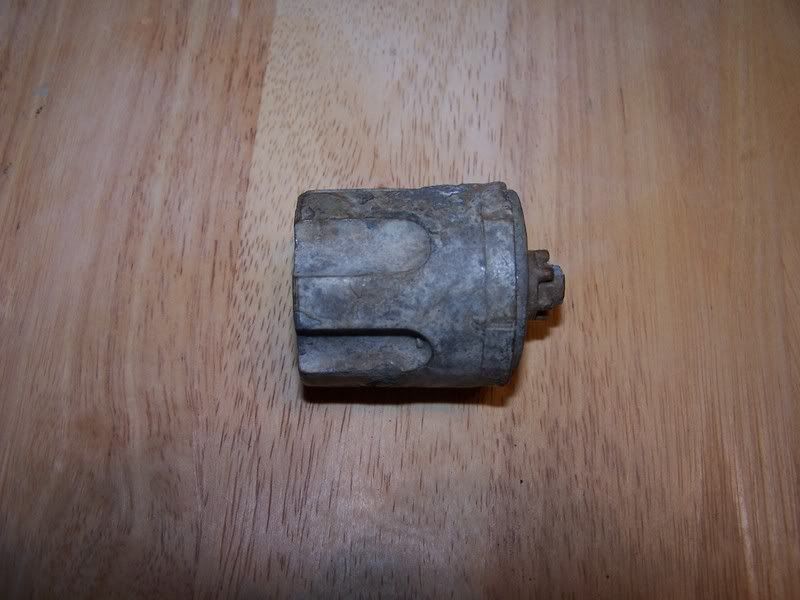
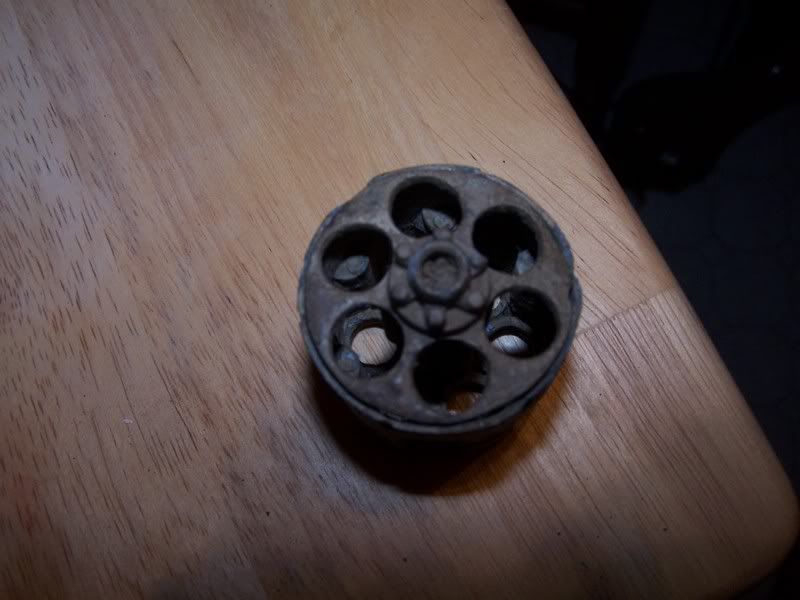
About ten years ago near the community of Rankin, I found some artifacts metal detecting. First I came across a cylinder to what appears to be part of a toy gun. I was thinking people may have dumped trash here. Then near a tree I came across a padlock then part of a belt buckle. The lock looked old and didn't have the connecting loop just the pad part. On the pad it says "RFD". Which I was thinking might mean Rankin Fire Department. But on the other side it says "MAIL". A little later by coincidence, a lovely postal employee brought to my attention that a new stamp was coming in commemoration of the 100 years of Rural Free Delivery by the US Post Office. So I'm guessing that possibly the pad lock was meant for a mail bag that had a belt around it. Or maybe the it locked a door to a cabinet. Also I was told by an old timer that once there was an old road that crossed the area where I found the pad lock. The road supposedly went across an area that is now a corp lake. Maybe something happened on the delivery or a hand off. It's possible that maybe somebody just used the lock for personal use and it ended up out here. If the mind wonders enough you could imagine some thief who stole a bag or something that was locked up and took it out here and cut off the lock.
Rural Free Delivery
The rural free delivery system also contributed to the development of a parcel post system and played an important part in the good roads movement. True to some of the dire predictions of its early opponents, however, RFD cut into the profits of main street retailers; brought an exotic and sometimes threatening urban culture into rural living rooms; and added to the growing sense that residents of small towns lived at the margins of a consumer economy dominated by America's biggest cities.
All those roads that go deep into the woods or the country pretty much were a result of people wanting to get there mail. You know how picky the mail can be if you have ever lived out in the country. If a road was too muddy or difficult the mail wouldn't deliver. The person out in the country would have to ride or walk into town and get their mail. I have read where some citizens took it upon their selves to finance some good roads to their place so they could get their mail delivered. They weren't going to wait on the government.
THIS VIDEO IS FROM 1903 AND SHOWS A RURAL FREE DELIVERY HAND OFF. I DON'T KNOW THE LOCATION. BUT YOU CAN DEFINITELY TELL IT IS RURAL.
Here is a mail drop off Aug 22, 1903. Cute little kids walking buy witrh their dog in the lead.
 Commemorative stamp
 Old picture of a RFD wagon
 another old RFD pic
PICTURES OF THE PAD LOCK


LINKS TO PICTURE OF THE TOY GUN CYLINDER
CYLINDER
CYLINDER1
CYLINDER2

CYLINDER PART

Monday, August 6, 2007
The Night They Drove The Settlers Down To Waxahachie And How Soap Creek Got It's Name
--------------SOAP CREEK------------------

Ok, the title is stretched to try to match the classic song by The Band. But one day in early Ellis County History half the settlement near Alvarado fled to Waxahachie. The new settlement was made up of Ovillians who decided to start there own community. Rev White was a resident of Ovilla at the time of the evacuation but was asked to come teach in the new community for the Summer. My guess is that the event happened in the 1850's. Seeing that the Rev started living in Ovilla around 1850. This event also gave Soap Creek it's name. Which it still holds today. The above picture is where 67 goes over Soap Creek. Which might have been where they crossed Soap Creek during their evacuation. They could have crossed further south because the story says the end up on a high point south of Waxahachie. Soap Creek follows VV jones road for awhile and ends just south of Midlothian. I thought it interesting how the Rev White shrugs off the danger but still evacuates because he wants to visit a young lady in Waxahachie. I wonder if the young lady he wanted to visit was his first wife? Anyway read his recount to find out the reason for the evacuation and then what was the true story behind the bru-ha-ha. The incident is referred to as Mitchell's War.
Here is the recollection Of Rev. R. M. White:

Ok, the title is stretched to try to match the classic song by The Band. But one day in early Ellis County History half the settlement near Alvarado fled to Waxahachie. The new settlement was made up of Ovillians who decided to start there own community. Rev White was a resident of Ovilla at the time of the evacuation but was asked to come teach in the new community for the Summer. My guess is that the event happened in the 1850's. Seeing that the Rev started living in Ovilla around 1850. This event also gave Soap Creek it's name. Which it still holds today. The above picture is where 67 goes over Soap Creek. Which might have been where they crossed Soap Creek during their evacuation. They could have crossed further south because the story says the end up on a high point south of Waxahachie. Soap Creek follows VV jones road for awhile and ends just south of Midlothian. I thought it interesting how the Rev White shrugs off the danger but still evacuates because he wants to visit a young lady in Waxahachie. I wonder if the young lady he wanted to visit was his first wife? Anyway read his recount to find out the reason for the evacuation and then what was the true story behind the bru-ha-ha. The incident is referred to as Mitchell's War.
Here is the recollection Of Rev. R. M. White:
"a report was circulated that the Indians were coming in overwhelming numbers, killing people along their route and devastating the country. They had taken the forts, so it was said, and were marching along in triumph. A courier was sent from Waxahachie notifying us of our danger and requesting us to be at that town before nightfall, for safety and defense A council of war was called to meet at the school-house, and after discussing the matter it was very much doubted whether the Indians were on the war-path; yet, as a matter of courtesy to the "Waxahatchets, combined with a faint probability that the report might be partly true, a rendezvous was appointed at the corner of Captain Bache's field. About one hour by sun the entire settlement had arrived in their wagons, with wives and little ones and such household goods as they could bring under the circumstances. The order being given to march, Aunt Susie Billingsly mounted a rock and called the assemblage to order. She then referred to their bravery and heroic conduct in Tennessee, Arkansas, and other sections where they had settled new countries; where they had fought and driven out the Indians, and now when they were more numerous and with no Indians within a hundred miles, they would flee from their homes and all they held dear! " Where, O, where," said the staunch old lady, " is your heroism of former days?" She then avowed that she could and would whip all the Indians that came; that they could do as they pleased, but that she, like Joshua of old, was going back home and would sleep soundly under her own roof. Thereupon, about one-half of the party returned to their homes, the others taking up the line of march for Waxahachie, I among the number, not that I believed the report, but I wished to come home any way to see friends, and especially a certain young lady. This I could consistently do, as I would have but little school where half or more of the children were gone. So, on we traveled, the wagons squeaking, as they were the wooden-axle sort, and no grease upon them. I and the young ladies put in the time singing and laughing to drown the noise of the wheels and the discordant jingle of bells, which were numerous. One good old sister called us to order, saying she thought prayers would be more appropriate to the occasion, as we did not know what moment we would be killed. I replied that if we had not prayed before, it was too late now, and that scared prayers would not avail much, if anything. On we went until finally reaching a creek, the largest one in the valley between Alva-rado and the Ovilla settlement. Going down the bank of this stream, which was steep, the goods of Mr. John Balch burst the front end gate of the wagon bed and the contents of the wagon, among which was a half barrel of soft soap, were spilled into the creek. I exclaimed, " Soap creek," which name it bears to this day. The damages being repaired as well as we could under the circumstances and the goods placed in the wagon, we moved on, reaching the top of the eminence south of the city of Waxahachie before daylight; then on to the houses of friends, and especially to the domicile of my dulciana. The Waxahatchets had gathered into the town and put out guards, some of whom were still at the ford or bridge of the creek south of the town. Seeing something in the distance they imagined that they saw a vast body.of Indians approaching the town. They gave the alarm and scouts were sent out to reconnoiter, when they discovered the visitors to be a herd of cattle that had stationed themselves on the eminence, as is their custom, to rest and ruminate. Day arrived and it was learned that the foundation for the alarming rumor was that a man had gone out to trade with the Indians and had taken too much of the devil's ale with him, which the redskins drank freely. The trader thought that when he had gotten them under the influence of the liquor he could cheat them more easily, but they caught him at his tricks and were about to get in their work on him, when he fled, and spread the report as stated above. Peace being restored, the settlers returned to their homes, doubtless wiser from their experience."
Monday, July 30, 2007
Update:The County Farm History Found

Well I found some more detailed information on the County Farm. It appears in the previous post about the county farm, Blog for Ellis County Texas History: The County Farm ,that Guru Bob and I were both right. It was both a pauper's farm and they did send nonviolent offenders to work of their debt at the County Farm. The prisoners were sent there towards the end of the use of the property. Somwhere in 1960 they stopped using it. Thanks to the research of Ruth Stone in the History of Ellis County book. I have attached her article below.
Ellis County Farm
by Ruth Stone
At the February term of the Ellis County Court, in 1882, a committee consisting of W. D. Ryburn, John Farrar, and M. B. Templeton was appointed to investigate the possibility of purchasing a farm to be used as the Ellis County Poor Farm, and to gain all information they could as to the practical workings of such a project.1
Investigations of various farms were made, which finally resulted in the purchase of one just east of Waxahachie. This farm contained 370 acres, 200 of which were under cultivation. The farm was established as a County Farm in October 1883, and became self-sustaining. The number of paupers usually averaged about 7 or 8, with more whites than negroes.
The first keeper was John Evans, who ran it for one year. Then Wm. Ralston took charge and kept it 4 years. E. J. Garrett held the position of manager for 1 year. Wm. Ralston again took charge of the Farm and was still holding the position in 1892.2
The Farm has been operated under much the same set-up through the intervening years. In 1959, the farm consisted of 470 acres. The manager for 17 years was Mr. Gene Rothrock, who operated it upon a paying basis. In 1961 he retired and A. J. Robertson succeeded him.
It is no longer considered a Poor Farm exclusively. It is rather, an extension of the County Jail system. The work on the farm is done by prisoners who are unable to pay fines for misdemeanors. There are usually anywhere from one to 20 prisoners, mostly Negroes and Mexicans. These prisoners are either sentenced by the County Judge because of being public nuisances, or to work out fines that have been imposed upon them. They are allowed $3.00 per day to apply on their fines. The prisoners work on the farm or on the roads, with an overseer for every 7 or 8 men.
The farm is county property, and expenses are paid out of the County general fund.3
Notes
*No longer used as county farm. Circa 1960. Ellis County Records, Vol A. Page 164, 356, 359-60. Memorial and Biographical History of Ellis Co. 1892, page 132. "Interview with County Commissioner, E. J. Kendall
Sunday, July 29, 2007
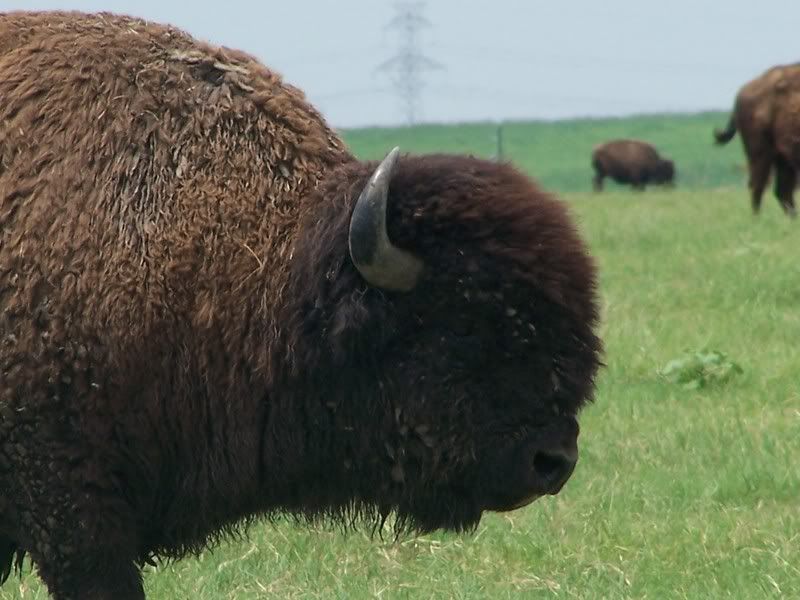
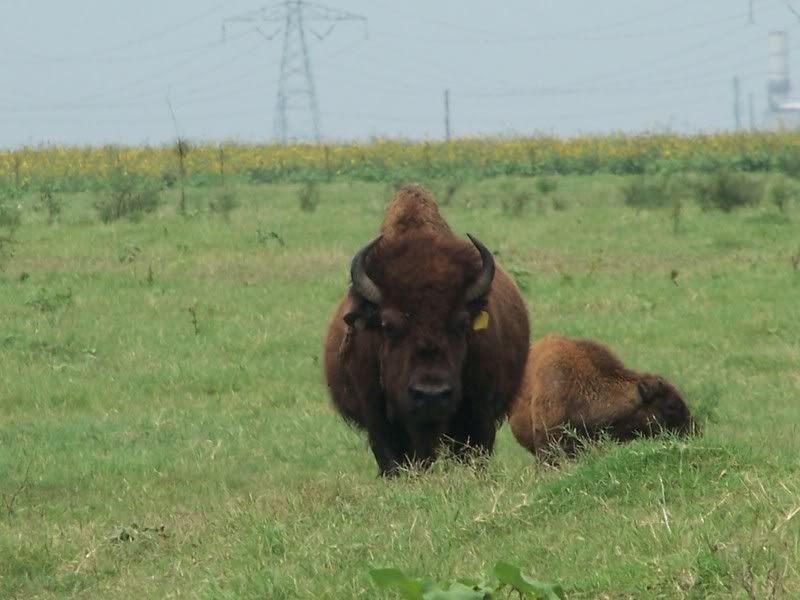
Ellis County, where the Buffalo Roam?
 VIEW FROM MOUNTAIN PEAK ON 875 LOOKING DOWN ON A HERD OF BUFFALO
No, it is not the wild buffalo of old. They are domesticated fenced in animals. But maybe it gives you an idea what it might have looked like in the early days of Ellis county when herds of Buffalo would cover the valleys. Of course you have to imagine 5 to 3 thousand in a herd. As an old timer said "Buffalo covered the prarie as far as the eye could see"
From the book History of Ellis County pg 90 Here is a couple recollections from Rev. R. M. White
"In addition to the grand scene presented to the view, were the vast herds of animals that roamed at will over the prairies, ruminating upon the luxuriant and succulent grasses, both wild and domesticated. Buffalo, cattle, deer and antelope were all fat and sleek as though kept in the stalls of some breeder of fine stock, and when they roam, either in play or from fright, it looked as if the whole surface of the earth was moving, the very ground seeming to tremble with their tread, the sound of their feet being as the sound of " many horses running to battle, " while the snort of horses and the grunt of cattle and buffalo formed a combination of sounds that were not altogether in harmony, nor calculated to inspire courage either in man or beast, for but few horses would stand in their pathway, especially of the buffaloes;
 and it was well for the bison of the plains never turned their course for anything, animate or inanimate, over or through which they could pass, neither branch nor creek."
"In illustration of their habits I will give an instance. A herd of buffalo was discovered in a valley near a creek and a number of men determined to have a chase and kill some of them; so they went out, some taking positions at the upper end of the valley, while others ranged themselves on each side; still others went below to bring on the engagement, which they did. The buffalo fled up the valley and the men in the rear following. When they came to the men stationed at the upper end of the valley in the path the buffalo they supposed would take, but which they did not, they found one of the watchers sitting on the ground at the root of a tree, with arms and legs around the tree, who asked as they came up whether the buffalo had gone, and if they had, that he would come down. Pretty badly scared, when he could not tell whether he was up the tree or not! The laugh was on the man for many year? afterward, and he was frequently asked to go buffalo hunting!"

"On another occasion a party of men went out on a buffalo hunt, and coming upon a large herd were making preparations for the slaughter, but the animals, scenting their enemy, stampeded. One man happened to be in their pathway and as his horse would not stand before them he ran off. There was a medium-sized branch in front of the fleeing horseman, and for this he made, hoping to cross and run up stream before the buffalo reached it; but in going down the bank the horse fell and the rider tumbled off. Before he could recover, the frightened herd came dashing toward where he lay and he expected every moment to be trampled to death by a thousand hoofs; but the buffalo, as is their custom, jump all small streams. This they did, and the man lay secure as the entire herd passed over him in the air. One failure of the beasts to make the leap would have been instant death. He tried to pray but could not think of anything to say, he was so badly scared."
When settlers first got here around 1844 there were Buffalo everywhere and their favorite "haunt" was on the lower Mustang Creek country. They watered on the land owned by W.H. Getzedaner and the Boren branch. By 1847 Ellis County had seen it's last Wild Buffalo. Their near extinction helped drive out the Indian's from the settler areas. Lots of money was made off their hides. Hides could fetch $3 and a heavy winter hide up to $50.
To find the location of the Maypearl Buffalo click this link Maypearl Buffalo
All these pictures were taken in Maypearl, Texas July 29th 2007
Here are links to more pictures Buffalo Head
Buffalo side

Buffalo ready to charge
Thursday, July 12, 2007
The County Farm

Participating in a hand held GPS club, Geocaching, I ran across a very interesting hide Southwest of the community of IKE on Farm Rd 878.
According to geocacher Gurubob
"This site was once an African-American prison farm. Many men lived and died here paying their debt to society. They worked this (some 300+ acres) and several other County farms. I surveyed the property a couple of years ago. During the survey an old man that had grown up on an adjoining property told me he had seen several men buried on this farm. Only a few of the graves have been established but, many are still unlocated."
Well the fact that Gurubob thought it was an African-American prison farm, may be a case of mistaken identification.
 According to a cemetery historical marker(N 32degrees 23.335 W096degrees 47.552) on 879 directly Southeast of the County Farm building ,
 "ELLIS COUNTY FARM CEMETERY, "This fenced area marks the boundaries of what has sometimes been called the pauper cemetery, one of possibly three burial grounds on old county farm land that served as the final resting place for some Ellis County's poor farm residents. County officials purchase 450 acres between 1893 and 1895 to create the farm for the support and employment of the needy. The earliest death recorded at the facility was that of Albert Estes in 1890; the last was Dave Madison in 1946. Iron pipes driven into the ground once identified the graves of some of the other 73 individuals whose names are recorded in county records."

So I'm thinking that maybe there were poor blacks that work the fields but not any prisoners. Or maybe it is possible that some of the not so dangerous criminals were given the option to work on the farm. Whatever the case the site of the hallowed ground is in a tall grass field with a white rod iron fence boundary about 50 yards by 30 yards.

The building is made of brick and had electricity at one time. It has a main entry room and around ten small rooms. The small rooms are small. Like 10 feet by 6 feet but about 10 feet high. The bricks say "standard" on them. It appears the roof had a brick wall around it but is crumbling.
 It has a hallway that cuts the building in half longways. That does make it appear like a jail walkway.
  Above the doors is a wood rectangular frame. probably window you could open. The first time I had visited the place it seems like I remember seeing iron bars over one end window opening. If I ever find the picture I will post. It may be a faulty memory.
I ran into a nice guy (even though he is an Aggie fan) on a 4 wheeler while I was touring the building. He said his family has lived on the surrounding land for years and that his brother and him had camped in the dilapidated county building as kids. He always believed it was a prison farm. Apparently there were more buildings to the farm. It is still owned by the County because I read a "letter to the editor" of the Waxahachie Daily Light by Jimmy Simmons. Mr Simmons suggests that an alternative to the Ellis County's 53.875 million dollar facilities bond could be partial solved by building an "adequate facility" "on the county farm, for instance, for a relatively small amount." I found Simmons Letter to the Waxahachie Daily Light on Joey Dauben's Ellis County Observer.
UPDATE LINK: Blog for Ellis County Texas History: Update:The County Farm History Found
Subscribe to:
Posts (Atom)
